

Life Insurance Riders

Life insurance riders allow you to customize your policy, so you can meet your family’s exact needs.

Life Insurance Riders

Life insurance riders allow you to customize your policy, so you can meet your family’s exact needs.

Understanding Life Insurance Riders

Buying life insurance can help you secure your family’s financial future if you were to die. But sometimes, you need more protection than your policy alone can provide. Adding life insurance riders can help provide extra support to your loved ones in situations beyond the scope of your original coverage. Life insurance riders are optional features you can add to a life insurance policy to customize your plan. They allow you to adapt your coverage to match your lifestyle, your health, or your loved ones’ financial needs. Once you’ve bought a rider, it will remain active for as long as your policy does, in most cases. While life insurance riders can increase your premium, they also deliver benefits beyond your regular life insurance policy. Planning ahead for you and your family can help you worry less about the future, knowing that you’re covered in a variety of situations. Insurance companies will have different riders, rates, terms and conditions, and levels of coverage. Our agents at eFinancial can help you review your options including discussing any available riders that will help you meet your needs.

The coverage you need, when you need it

An affordable, convenient option for many families.

Benefits of Life Insurance Riders

Why add insurance policy riders to your life insurance plan? With a life insurance rider, you can:

Create a customized policy

Make your life insurance policy your own by including riders that offer extra financial protection for your child, allow you to stop paying premiums if you are disabled and can’t work, or make other accommodations for your needs.

Add benefits to a new or existing policy

Maybe you’ve found a policy you like, but it doesn’t offer enough of a payout for your family. Or maybe you’ve taken on a bigger mortgage after you’ve already bought a policy. Guaranteed insurability riders allow you to increase your life insurance payout to meet your family’s financial needs.

Mix and match as needed

You’re not limited to just one rider or rider type. Depending on your financial situation and goals, you can easily add multiple riders to the same policy.

Pay lower premiums by combining insurance

Some riders let you turn your term life insurance into a permanent life policy or insure an extra person, like your child, without having to go through the whole approval process again.
Types of Life Insurance Riders

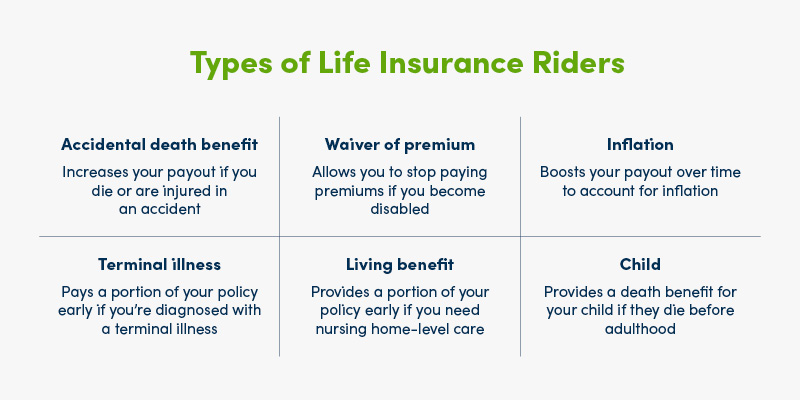
There are a wide range of life insurance riders available to help you secure additional coverage, protect your paycheck, safeguard against serious illnesses, or cover any outstanding medical bills and nursing home care. Depending on your needs, eFinancial can help you with understanding life insurance options and adding any of the following types of riders in insurance to your policy.

Accidental death benefit

This type of rider offers an additional cash benefit to your loved ones if you die because of an accident. In many cases, the payout amount is equal to the face amount of your policy – which means your family or loved ones end up with double the payout than if you had died of illness or natural causes. That’s why it’s sometimes called a double indemnity rider. Some of the accidents that may be covered under your rider include:
  • Car or traffic accidents
  • Airplane crashes
  • Falls
  • Workplace incidents
  • Fire-related injuries
  • Firearm accidents

In some cases, an accidental death rider, or accidental death and dismemberment (AD&D) rider, may also cover major non-fatal injuries that prevent you from working. These can include limb loss; loss of hearing, eyesight, or speech; or partial or permanent paralysis. This type of coverage can provide critical protection to your family, especially if you work in a career where you’re more exposed to potential accidents. Considering an accidental death benefit rider? Make sure that you know how your life insurance company defines accidents, since there might be limitations on when they are willing to pay. If your injury or death is related to suicide or happened while you were under the influence of drugs or alcohol, your rider may not cover you, either. You also might not qualify for coverage if you have hobbies like skydiving or mountain climbing or if you work in a high-risk job like law enforcement, firefighting or the military. Keep in mind that a rider is different from an accidental death benefit or ADB policy, which is standalone coverage you can buy separately from your life insurance policy. Our agents at eFinancial can help you compare your options to find the best fit for you.

The waiver of premium rider for disability allows you to stop paying your monthly premiums if you become permanently disabled and can’t work. 

With this rider, your insurer will waive all remaining premiums until you are ready to work again, while your coverage remains active. Once your disability ends, your payments start again. If you remain disabled for the length of your term insurance plan, you won’t have to make payments, but your coverage stays in place. 

A waiver of premium rider works well for people with a range of financial needs. Whether you run a business or are the main breadwinner in your family, these riders can help protect anyone who would be burdened financially by your lost income. This type of rider can be particularly helpful for high-value policies, which typically come with high premiums that can be tough to maintain after a job loss. 

While this benefit can be invaluable, it’s important to review the fine print before signing up. Here are some points to consider:

  • Each company has its own definition of “disabled.” While some companies will honor your claim if you cannot return to your original occupation or line of work, others might specify that you don’t qualify if you’re still able to perform any type of work. If you are already disabled, you also won’t be able to qualify for this rider.
  • Waiver of premium riders usually expire at a predetermined retirement age because they are only meant to provide a financial safety net during your working years. The expiration age ranges depending on the provider, but it’s typically anywhere between 60 and 70 years old. 
  • The rider typically includes a waiting period before the benefit kicks in, so you’ll need to find a way to keep up with your premiums during that time. The waiting period can last anywhere from a few months to a year.
The inflation rider boosts your policy’s cash payout over time to account for inflation. Inflation riders are designed to adjust the dollar amount of your coverage to help you keep up with rising costs, such as medical care or housing. Generally, your death benefit will increase by a fixed percentage every year to address inflation and rising expenses. Increased coverage does mean a higher premium, but you can end up saving thousands of dollars on future care and end-of-life costs. You can add these riders to current life insurance plans, such as term life policies. The types of inflation riders available will vary depending on your provider. The main types of riders available include:
  • Guaranteed purchase option (GPO). You can buy the option to increase the amount of your coverage every two or three years during your term life plan, without having to get approved multiple times.
  • Simple inflation protection. This rider increases your death benefit automatically every year by a percentage you choose with your insurer, usually 3% to 5%.
  • Compound inflation protection. Like simple inflation protection, your coverage amount would increase by a percentage each year with this type of rider. The difference is that instead of a flat rate, your benefit goes up with compound interest, rather than rising by a flat amount each year.
Inflation riders can be expensive, so think about whether it’s better to pay extra for this rider or put those funds toward other financial priorities, like an emergency savings fund. The cost also depends on which type of rider you buy. A life insurance agent can walk you through your options to help you make the right choice.

The terminal illness rider offers a cash payout for you or your loved ones if you are diagnosed with a terminal illness. This rider is often free with your policy or available at a fairly low cost. Also known as an accelerated benefit rider, it’s like a cash advance on your policy. In many cases, you can access a significant portion of your total death benefit, up to 75% in some cases.

These riders are different from critical illness riders, which cover you if you are diagnosed with a serious but curable condition or a chronic illness. Terminal illness insurance is specifically designed to offer your loved ones financial security once you are at the point where recovery is unlikely.

Just like the death benefit from your policy, your family can use this money for whatever they need. It can help defray the costs of your care, cover hospice or medical bills, or replace your income if you are no longer able to work. The funds don’t have to go toward care, though. You can even use the living benefit to pay for a vacation or anything that can help you enjoy your final days with your family and friends. 

If you pass away before your term ends, your beneficiary will still receive the remaining portion of your policy’s death benefit. You do not have to repay this money if you outlive your policy.

The living benefit rider provides a payout if you’re diagnosed with a critical or chronic illness or need to move to a nursing home. 

On average, nursing home care costs about $7,700 to $8,800 per month in the United States, and about 48% of adults receive some paid senior care over the course of their lifetime. A living benefit rider can give your family peace of mind and a way to cover these substantial costs if you end up needing this type of care. In some cases, the living benefit rider can also help pay for home health services.

Most living benefit riders will pay out benefits if you’ve been diagnosed with a critical illness, chronic illness, or terminal illness. They will need to see proof of your diagnosis before making the payment. In general, life insurance companies often determine that you meet the criteria for this rider when your primary care doctor feels that you are unable to complete two or three of the six activities of daily living: bathing, dressing, eating, toileting, walking, and continence. 

If you’re interested in this type of protection, talk to your life insurance agent about any rider options available with your plan. Many companies now include the living benefit rider at no additional cost to you.

If you’re a parent, the child rider provides a death benefit to you if your child passes away before a specific age. This money can provide a financial cushion to cover funeral, medical, or other expenses after a tragic loss. Typically, the payout is a few thousand dollars, and the rider itself is very inexpensive.

Beyond covering immediate needs after a loss, though, many people buy the child rider as a financial investment for their child. A child protection rider is typically term life insurance coverage that lasts until your child is between 22 and 30 years old, depending on the policy. Once your child reaches that age, they can often convert it to a permanent life insurance policy, with coverage up to five times the original amount and without the need for a medical exam. This is a great way to guarantee their insurability and make sure that they are covered once they become adults, even if they encounter health issues before then.
Should I add a life insurance rider to my policy?

For many people, a life insurance rider offers additional protection where they need it most. Keep in mind, though, that riders often come with an additional cost.

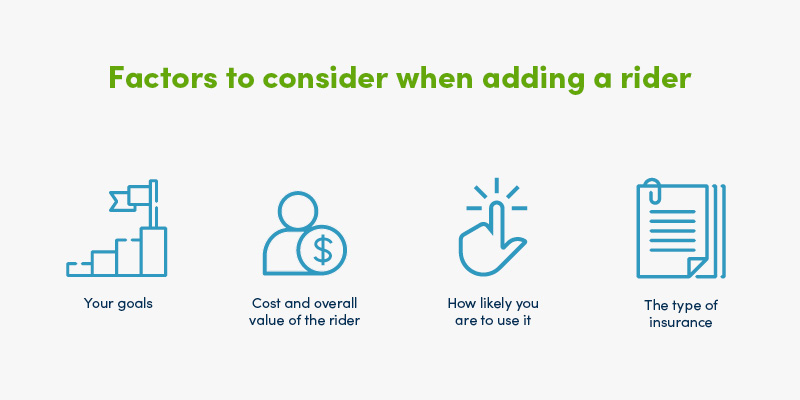
Here are some things to consider when you decide whether to add a rider and which to buy:

  • What are my goals? Different riders can help you accomplish different things. If you are the primary wage earner in the household, for example, an accidental death benefit rider can help increase your family’s financial cushion and a waiver of premium rider can help ensure your life insurance premiums are paid if you become disabled.
  • How much will it cost? Part of the reason term life insurance is a good choice for many families is because it’s so affordable. In general, term life insurance is three times less expensive than most people think. The average cost of $250,000 term life insurance for a healthy 30-year-old is about $160 a year. The added cost for a rider might be small, but it can add up over time, especially since people hold life insurance for decades in most cases. If the rider you’re thinking about is free to add to your policy, there’s no harm in adding it. If it costs extra, make sure to weigh the costs with the benefits.
  • How likely am I to need it? Life is uncertain, and it can be hard to know what financial needs might come up. Still, it’s important to think about how useful a rider could be to decide whether it justifies the cost. If you have a history of cancer in your immediate family, for example, a terminal illness rider might give you more peace of mind. If you’re buying term life insurance in your 50s or 60s, the living benefit rider often makes more sense than for someone in their 20s and 30s. Ask yourself how valuable it might be – and the risks involved in not buying it.
  • What’s the overall value of the rider? Some riders, like the child rider, offer a guaranteed return on your investment. Others, like the waiver of premium, only offer value if you become sick or disabled. Think about what you’re paying for and whether it’s worth the cost.
  • What type of life insurance am I buying? Riders are available for both term life insurance and permanent life insurance, but some riders are only available for certain policy types. A life insurance agent can help you understand your options for insurance rider policies.

How life insurance riders work

In most cases, you choose your life insurance riders at the same time as your life insurance plan. Your insurance company will factor in any additional cost for your rider as part of your premium payment. If you decide later that you’d like to add a rider, some life insurance companies will allow you to add them to an existing policy. Once you purchase a rider, it will be in place for the same amount of time as your term or permanent policy. One caveat: If you make a claim on the rider while your policy is active, it might end up terminating your rider, even if your original policy continues to cover you.

Life insurance riders through eFinancial

Adding riders can be a great way to customize your life insurance policy around your needs. Whether you know exactly what you’re looking for or need help finding the best options, we’re here to make the process as easy as possible. We offer a range of products from top-rated life insurance companies, and our agents are here to guide you each step of the way.

You've Got Questions. We've Got Answers.​

Need help deciding if a life insurance rider is right for you? Here are the answers to some of our most common questions:

How much do insurance riders pay out?

That depends on the amount of coverage you choose. Each rider is unique, and every provider has its own payout policies. Get in touch with our team at eFinancial to learn more about your options.

There are several things that affect how much you’ll pay for your life insurance riders. Some of these include:

  • Your current health
  • The amount of your cash payout (death benefit)
  • Your term length, if you have term life insurance
  • The type and number of riders you choose

You can find life insurance riders for both term and whole life policies. Keep in mind that each life insurance company offers different options, though. If you have a specific rider you want to add to a new term or permanent life policy, we’ll work to help you find the right provider. We can also help you add riders to your current life insurance plan.

Get your quote online, or talk to one of our agents at 844-704-1641